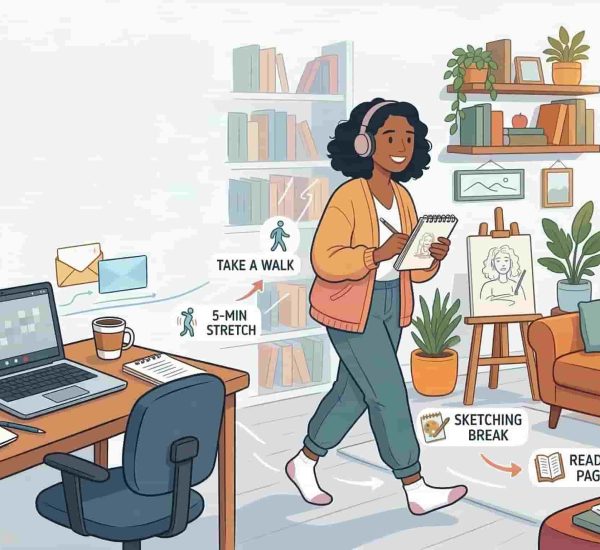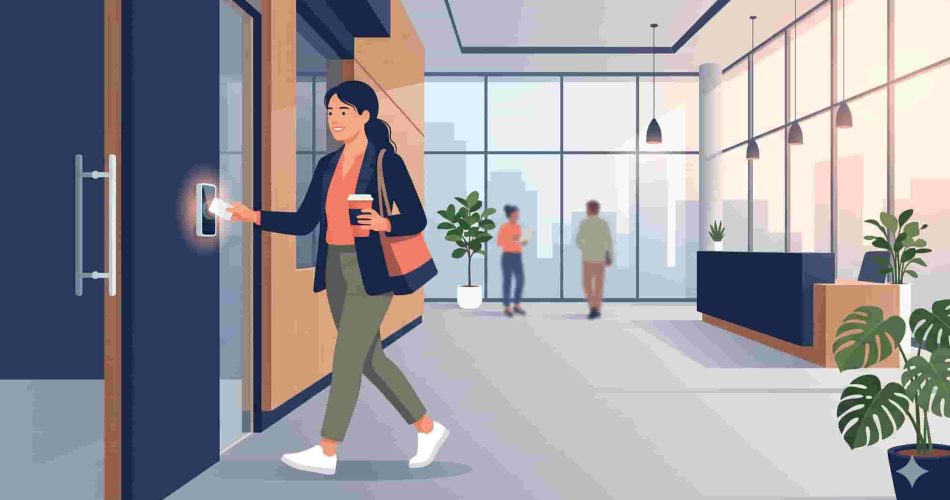
Picture this. It’s 8:45 on a Tuesday morning. An employee walks into the office, orders an oat milk latte from the lobby café, swipes their access badge, makes a lap through the open plan, has a ten-minute chat by the espresso machine, attends a standup, and then quietly disappears by 10:30. By 11:00 AM, they’re back home doing the deep work they couldn’t focus on in the office anyway. This is coffee badging – and in 2026, it is no longer a fringe behavior or a quirky Gen Z habit. It is a widespread, economically rational response to how return-to-office mandates are being enforced across corporate America, the UK, Canada, and Australia.
According to Owl Labs’ State of Hybrid Work Report, 43% of hybrid employees admit they sometimes go to the office for a few hours just to show their faces – and another 12% are planning to try it. That’s not a fringe trend. That’s a structural signal – and most companies are reading it wrong.
Coffee badging is when employees show up at the office briefly – just long enough to swipe a badge and be seen – before leaving to work remotely for the rest of the day. According to Owl Labs, 43% of hybrid employees already do it, and another 12% are planning to try. In 2026, coffee badging has evolved from a workplace quirk into a rational economic response to rigid return-to-office mandates – driven by commute costs, noisy open-plan offices that fragment focus, and attendance policies that measure presence instead of performance. For HR leaders, it’s not a compliance problem. It’s a signal that the office needs a better value proposition.
What Is Coffee Badging?
Coffee badging is the practice of briefly appearing at the office – long enough to swipe a badge, grab a coffee, be seen by a manager or colleague – before leaving to work remotely for the rest of the day.
Featured snippet definition: Coffee badging is when an employee visits the office for a short period – typically under two hours – to satisfy in-person attendance requirements before working remotely for the remainder of the day. The term was coined by Owl Labs in their 2023 State of Hybrid Work report and has grown into one of the defining Gen Z workplace trends of 2025–2026, driven largely by aggressive return to office mandates and the rising cost of commuting.
The term gained mainstream traction when companies like Amazon and Samsung began tracking badge-swipe data to monitor whether employees were genuinely spending time in the office – and employees responded by gaming the system in the most efficient way possible. Even 47% of managers admit to coffee badging themselves, which says something important about how universal the behavior has become across organizational hierarchies.
The $51 Problem: Why Coffee Badging Makes Economic Sense
Framing coffee badging as laziness or disengagement misses the actual driver. It’s economics.
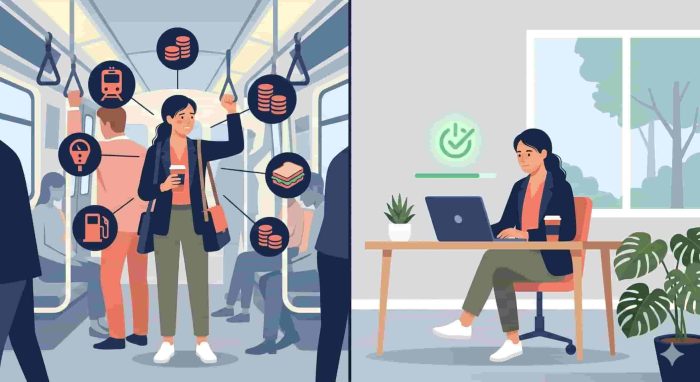
Owl Labs found that workers spend an average of $51 per day when they go into the office – lunch, coffee, transport, and parking. For hybrid workers going in eight days a month, that’s $408. For full-time office workers, that exceeds $1,000 monthly.
That’s commute inflation – the invisible tax employees pay to comply with attendance mandates they didn’t sign up for when they accepted remote or hybrid roles. For Gen Z workers entering the workforce with student debt and rising rent costs, this math is not abstract. It’s a monthly budget line item that directly competes with savings, rent, and discretionary spending.
Add the distraction tax – the cognitive cost of noisy open-plan offices that fragment focus – and the calculus shifts further. For knowledge workers whose best output requires deep concentration, a full day in a busy office can represent a net productivity loss, not a gain. Productivity vs presence has never been a more live debate than it is in 2026, and employees have already chosen a side.
Gen Z isn’t being lazy. They’re being rational. Coffee badging is what rational productivity vs presence optimization looks like when the system gives employees no better option.
Why Gen Z Sees the Office as a Social Ritual, Not a Requirement
Here is something companies enforcing rigid return-to-office mandates consistently get wrong: Gen Z doesn’t hate the office. They hate mandatory, undifferentiated office time.
According to Monster’s 2025 Coffee Badging survey, 17% of employees say coffee badging is about enjoying the social atmosphere of coworkers – not avoiding work. The office, for younger workers, is most valuable as a social and collaboration space. It’s where energy is exchanged, relationships are built, and creative conversations happen spontaneously. It’s not where deep individual work gets done best.
When the office is used intentionally – a team day, a project kickoff, a brainstorm that genuinely benefits from in-person dynamics – Gen Z shows up fully. When it’s a five-day mandate where most of the day involves being on the same Zoom calls they’d be on at home, they show up minimally.
The shift is from routine to ritual. The office as a ritual space – meaningful, chosen, collaborative – motivates genuine presence. The office as a compliance requirement, produces coffee badging.
If nobody important is in the building, or if the day’s agenda is indistinguishable from what could be done remotely, employees feel no compelling reason to stay. That’s not disengagement. It’s efficiency.
The Failure of Badge-Swipe Culture
The corporate response to coffee badging has often made things worse. Samsung rolled out an attendance compliance tool for managers. Amazon began one-on-one conversations about the number of hours employees spent physically in the office. Badge-swipe dashboards became HR metrics.
This approach treats a systemic problem as an individual behavior problem – and it backfires.
Coffee badging highlights the ongoing tug-of-war between strict office mandates and employees’ desire for autonomy. When companies respond to that tug-of-war with surveillance, they don’t solve the underlying tension. They deepen it. Employees who felt mistrusted begin to disengage more, not less. High performers – the ones with options – start looking elsewhere.
The distinction that matters here is visibility vs surveillance. Visibility means a team can see who’s in the office, who’s working remotely, and who’s available for collaboration – enabling coordination without judgment. Surveillance means tracking badge swipes, monitoring desk occupancy, and measuring employee worth by time spent on-site. One builds trust. The other destroys it.
Attendance scoring and hybrid work visibility achieved through monitoring systems miss what actually matters: collaboration quality, deep work output, async productivity, and whether employees are delivering on their commitments. None of those things show up in a badge-swipe log.
Why Trust-Based Visibility Wins in 2026
The companies navigating coffee badging best in 2026 aren’t the ones with the strictest monitoring. They’re the ones that replaced attendance mandates with coordination systems.
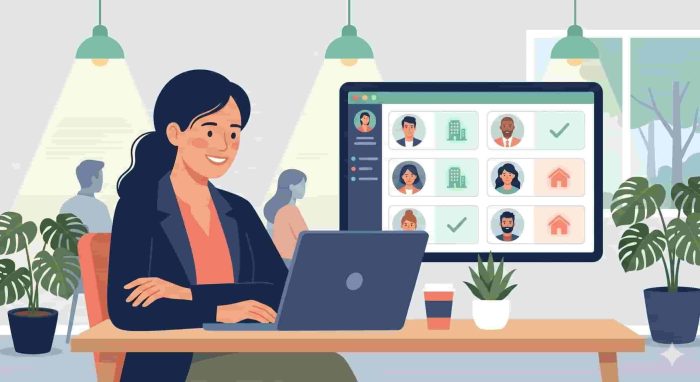
The practical version looks like this: instead of requiring badge swipes, teams share their daily status – in office, working from home, traveling, focused time – inside the tools they already use. A manager can see at a glance that three team members are in the office on Thursday and plan a meaningful in-person session around that reality, rather than mandating presence on a day when nobody’s actually there.
The smartest hybrid companies stopped asking ‘Are people here?’ and started asking ‘Can teams coordinate effectively? AttendanceBot works this way inside Slack and Microsoft Teams. Employees set their status – in office, remote, or on leave – through a simple Slack message. Managers see real-time team availability without badge readers, surveillance software, or manual attendance logs. The model is transparent by choice rather than compliance by force, which is the only version of hybrid work visibility that doesn’t create the exact resentment that produces coffee badging in the first place.
This isn’t about being soft on accountability. It’s about recognizing that accountability built on monitoring produces performative compliance – the very behavior companies are trying to eliminate. Accountability built on trust and outcome measurement produces actual results.
How Managers Should Respond to Coffee Badging
Coffee badging is feedback. The response it deserves is strategic, not punitive.
Design offices around collaboration, not occupancy. If the office is a row of hot desks where employees spend the day on individual tasks, there’s no compelling reason to be there. Spaces built for teamwork, creative sessions, and spontaneous connection give employees a reason to choose in-person time.
Measure outcomes, not occupancy. Replace attendance indices with performance conversations. What did the team deliver? Where did collaboration add value? These questions matter more than who swiped in on which days.
Create intentional in-person days. Rather than blanket mandates, designate specific days when the whole team is expected in – with an agenda that makes in-person presence genuinely worthwhile. This gives employees a reason to be there, rather than a requirement to comply with.
Build async-first workflows. For teams using time tracking and leave management inside Slack, the foundation of async-first work is already in place. Daily standups, status updates, and coordination happen through structured Slack workflows rather than requiring physical co-location.
Reduce commute friction. Subsidize transport. Enable flexible start times. Acknowledge that the cost of commuting is real and design policies that don’t invisibly punish employees for complying.
The Future of the Office Is Intentional
Coffee badging exists because most return-to-office mandates fail to answer a basic question: what will I do in the office that I can’t do at home? Until employers have a good answer, employees will keep swiping in, grabbing their flat white, and heading out.
The companies that solve coffee badging won’t do it by tightening badge-swipe enforcement. They’ll do it by making the office worth staying for – designing spaces that enable genuine collaboration, building cultures where in-person time has clear value, and replacing presence-based management with trust-based coordination.
81% of workers prefer hybrid or remote arrangements over full-time office work. 83% say work-life balance matters more than salary. These aren’t negotiating positions. They’re signals about what the workforce values – and companies that ignore them will continue to watch their best people comply minimally and leave eventually.
The future of the office isn’t mandatory. It’s magnetic.
People Also Ask
What is coffee badging?
Coffee badging is the practice of briefly visiting the office – typically for under two hours – to satisfy in-office attendance requirements before leaving to work remotely. The term was coined by Owl Labs in 2023 and has become one of the most discussed Gen Z workplace trends of 2026, driven by rising commute costs and rigid return-to-office mandates.
Is coffee badging bad for productivity?
Not necessarily. Research consistently shows that knowledge workers often perform deep individual work better at home. Coffee badging becomes a productivity problem only when it replaces genuinely valuable in-person collaboration. When used to avoid performative presence – attending the office for no substantive purpose – it may actually protect productivity.
Why do employees coffee badge?
Employees coffee badge primarily for economic reasons – the average office day costs workers in commuting, food, and parking – and for focus. 21% say it allows them to balance remote work with in-office visibility for career growth, while 17% cite the social atmosphere as the main draw. Most are not avoiding work – they’re avoiding unnecessary presence.
How can companies track hybrid work without surveillance?
The most effective approach is self-reported status sharing inside existing tools like Slack or Microsoft Teams. When employees voluntarily share whether they’re in the office, remote, or on leave, managers have real-time hybrid work visibility without monitoring software or badge-swipe tracking. This model builds trust rather than eroding it.
What are alternatives to badge-swipe attendance tracking?
Alternatives include Slack-native status systems where employees share their daily location voluntarily, outcome-based performance measurement, intentional in-person scheduling rather than blanket mandates, and hybrid coordination tools like AttendanceBot that make team availability visible without requiring physical surveillance.